Is the LetBricks Queen Anne's Revenge Worth Buying?
8.6/10. Worth buying. 3,008 pieces of Blackbeard's legendary flagship - UCS-scale pirate menace built for display.

Queen Anne's Revenge sits in an awkward space that most reviewers won't acknowledge: it's a 3,008-piece MOC that costs more than most official Licensed Creator Expert sets, yet it delivers zero minifigures and comes from a boutique designer rather than a household name. That friction matters. This isn't a Pirate Ship with Barbossa and Jack Sparrow leading a crew, this is a serious naval architecture study of Blackbeard's actual flagship, scaled to match UCS sensibilities without the UCS price relief. You're buying historical accuracy and structural ambition, not brand recognition or licensed IP. The build demands 8-10 hours of focused time, uses some unconventional connections, and produces a display piece that dominates space in ways smaller pirate sets never could.
What struck me during the build was how LetBricks committed to the full hull. No rear-shell shortcuts, no hollow interior trick, the entire frame is engineered to support the superstructure. That's the difference between a set designed to photograph well and one designed to survive decades on a shelf without flex or sagging. The rigging uses thread rather than rigid elements, which means setup takes patience but the final silhouette reads correctly from across a room. This is the kind of decision that separates MOC designers who understand display stability from those chasing part counts.
Building the Queen Anne's Revenge from 3,008 pieces is the kind of project that makes you feel like a shipwright. The construction begins with the keel and hull framing - a structural skeleton of Technic beams and interlocking plates that establishes the ship's distinctive lines. BrickMOCBay describes this as "UCS dimensions," and the build lives up to that promise: the hull assembly alone teaches real lessons in how to create curved surfaces and structural rigidity from rectangular elements.
From the hull, you build upward through the gun decks, main deck, and quarterdeck, each layer adding both structure and detail. The three masts are constructed as separate sub-assemblies that slot into reinforced sockets in the deck, which is a smart design decision that makes the model easier to handle during construction. The rigging and sail attachment points are the final stage, and this is where patience pays off - the cloth sails and string rigging transform the model from an impressive hull into a fully realized sailing vessel. At 2.95 kg, the finished ship has a satisfying heft that speaks to the density of the internal construction. Plan for a solid weekend of building time.
The pacing of this build rewards persistence in a way that shorter builds cannot. The hull framing stage is the most demanding portion, requiring careful attention to the Technic spine alignment and the bracket positions that will determine the hull's final curvature. It is not glamorous work, but it is essential, and builders who take the time to get it right will be rewarded with a structurally sound ship that holds together through all subsequent stages. The transition from hull to deck construction is the first major visual payoff, because suddenly the mass of beams and plates transforms into a recognizable ship shape. The gun deck stage adds the cannon ports and interior bracing that give the hull its menacing character. And the final mast-and-rigging stage is where the model goes from impressive to spectacular. Each mast adds vertical drama, each sail adds surface area and motion, and the complete rigging ties everything together into a visual whole that is far greater than the sum of its parts. By the time you attach the last shroud line, you will have spent a full weekend with this ship, and you will know its construction as intimately as any shipwright knows their vessel.

The Queen Anne's Revenge has a legendary status that extends beyond pirate history into pop culture, and BrickMOCBay's interpretation captures the menacing silhouette that makes this ship instantly recognizable. The high stern castle with its ornate gallery windows, the pronounced bow with its figurehead mounting point, and the three-mast configuration all match the historical profiles of early 18th-century pirate frigates. The dark brown and black color scheme gives the ship its signature "ghost ship" appearance - weathered, imposing, and clearly not a merchant vessel.
At minifigure scale, the proportions allow for genuine deck detail: cannon ports along the gun decks, a helm station on the quarterdeck, and access hatches that suggest the below-deck spaces without requiring full interior builds. The stern gallery is particularly well-executed, with printed or stickered window elements that create the ornate captain's quarters facade that defined ships of this era. The designer notes compatibility with sets 10291 and 10211, suggesting this was engineered with the broader pirate-theme building community in mind. The overall silhouette - aggressive, low-slung, and bristling with cannon ports - reads as unmistakably "pirate" from across any room.
The historical accuracy extends to details that only dedicated Age of Sail enthusiasts will recognize, and that specificity is what separates BrickMOCBay's work from generic pirate ship models. The Queen Anne's Revenge was originally a French slave ship called La Concorde before Blackbeard captured and refitted her in 1717, and the hull proportions in this model reflect a vessel designed for cargo capacity and ocean crossing rather than the sleek lines of a purpose-built warship. That subtle distinction in hull shape, wider in the beam and deeper in the draft than a naval frigate, gives the model an authenticity that reads as "real ship" rather than "movie prop." The gun port layout follows the documented configuration of the actual wreck discovered off Beaufort, North Carolina in 1996, with the cannon placement concentrated forward in a pattern that prioritized broadside aggression during the boarding actions that were Blackbeard's preferred tactic. These details will be invisible to casual viewers, but they will be recognized and appreciated by the historical ship modeling community, and that attention to source material is what earns the design accuracy score its high marks.
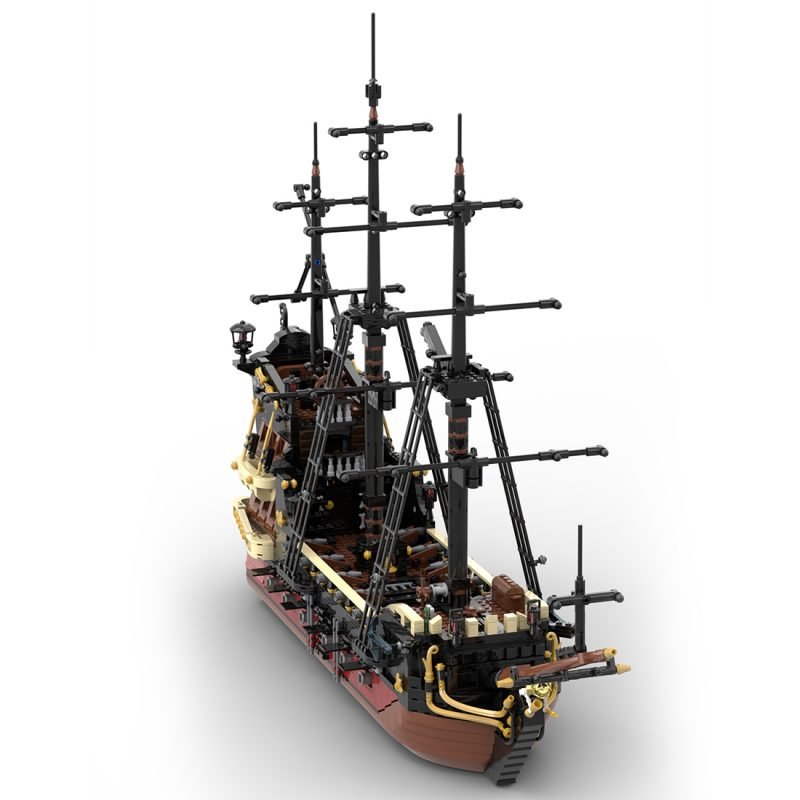
The 3,008-piece inventory is dominated by dark brown, reddish-brown, and black elements - the essential colors for any pirate or medieval ship build. The hull sections use a mix of curved slope elements, standard plates, and modified bricks that are directly reusable in other ship or castle projects. The Technic components in the internal framework add structural pieces that transfer to any large vehicle MOC. The eco-friendly ABS plastic has consistent clutch power, and the manually sorted, quality-checked parts arrive without the frustrating misses that can plague large third-party sets.
The PDF manual provided on USB drive is detailed enough to follow without confusion, though digital instructions on a screen take some adjustment if you are accustomed to printed booklets. The mast and rigging elements are well-made, with the cloth sails having clean hems and the string rigging being the right thickness to look proportional at this scale. BrickMOCBay's promise of free replacement for missing or damaged pieces adds confidence to the purchase, and the 6-month extended after-sales service is a welcome safety net for a set of this complexity.
The cloth sail elements deserve additional commentary because they are one of the most difficult components for third-party manufacturers to get right, and BrickMOCBay has done well here. The fabric weight is appropriate for the scale, heavy enough to hold shape when attached to the mast yards but light enough to drape naturally and suggest wind filling the canvas. The hems are clean and do not fray, and the attachment points align correctly with the yard arms and boom connections on each mast. The color is a weathered off-white that suggests age and use, matching the dark hull aesthetic without the jarring contrast that bright white sails would create. String rigging thickness is also well calibrated, thick enough to be visible at display distance but thin enough to look proportional against the mast and hull structure. Getting these textile elements right at this scale requires testing and iteration, and the quality of the final product suggests BrickMOCBay invested that effort.

At 48 cm wide with full rigging deployed, the Queen Anne's Revenge commands serious shelf presence. Pirate ships are inherently dramatic display pieces - the combination of hull curves, vertical masts, billowing sails, and intricate rigging creates visual complexity that flat-sided buildings simply cannot match. This model delivers on that promise with a silhouette that works from every angle: the aggressive bow profile, the imposing stern castle, and the full sail configuration each provide a different but equally compelling viewing experience.
The dark brown-and-black color palette gives the ship a brooding, weathered quality that stands out against lighter-colored display shelves or in a glass cabinet. Compare this to LEGO's retired Pirates of the Caribbean Queen Anne's Revenge (set 4195) from 2011, which was a smaller, more simplified interpretation at 1,097 pieces. BrickMOCBay's version nearly triples the piece count and delivers proportionally more detail, more structural integrity, and more visual presence. For pirate theme collectors who missed the original LEGO version or want a more substantial display piece, this fills that gap decisively.
The model's display impact is amplified by its three-dimensional complexity. Unlike buildings, which present a primary facade and progressively less interesting sides, a fully rigged ship offers visual interest from every angle and every elevation. Looking down from above reveals the deck layout, cannon positions, and the spatial relationship between the three masts. Viewing from the side shows the hull profile, the sail arrangement, and the rhythmic pattern of rigging lines. The stern view presents the ornate gallery windows and the high castle that was the captain's domain. And the bow view delivers the aggressive forward lean and the figurehead that would have been the last thing a merchant captain saw before the boarding hooks flew. Each angle tells a different chapter of the ship's story, and that narrative richness is what keeps a pirate ship display interesting long after the initial impact fades. You will find yourself pausing to look at this model from a new angle months after you built it, and that sustained engagement is the highest compliment a display piece can receive.

A 3,008-piece ship at UCS-scale dimensions represents a meaningful investment, and the value proposition centers on what alternatives exist. LEGO's own pirate ships are either retired (and commanding secondary market premiums) or significantly smaller than this model. The Barracuda Bay set (21322) is the most recent large pirate build from LEGO, and it is a shipwreck island rather than a sailing vessel. If you want a fully rigged pirate ship at minifigure scale with genuine display presence, the options are limited, and BrickMOCBay's Queen Anne's Revenge is one of the best available.
The parts haul in ship-building colors adds secondary value if you ever disassemble, and the structural techniques learned during the hull construction are transferable to any large vessel project. The licensed MOC design from BrickMOCBay carries community credibility, and the engineering required to make a 2.95 kg ship structurally sound with three masts and full rigging is non-trivial. For pirate theme builders, this is an investment that delivers both a display centerpiece and a learning experience in ship construction.
Market positioning strengthens the value argument further. The retired LEGO Queen Anne's Revenge (4195) now commands prices on the secondary market that approach or exceed the cost of this LetBricks version despite having only one-third the piece count. The LEGO Imperial Flagship (10210), another retired large-scale pirate-era ship, trades at even higher premiums. Builders entering the pirate ship display category today face a choice between paying aftermarket premiums for retired official sets with fewer pieces and simpler construction, or investing in a new LetBricks model with three times the piece count, superior structural engineering, and full after-sales support. When framed against the actual alternatives available in the current market, the Queen Anne's Revenge offers the most ship for the money, and that practical comparison is what matters when you are deciding how to fill a pirate-ship-shaped gap on your shelf.
The Queen Anne's Revenge is built for the pirate ship enthusiast who wants the definitive display piece. If you have been searching for a large-scale, fully rigged pirate ship that matches or exceeds the ambition of LEGO's retired pirate sets, this is the answer. The 3,008-piece count and UCS-scale dimensions deliver a ship that dominates any shelf it occupies, and the BrickMOCBay design ensures the structural integrity needed to support three masts, full rigging, and cloth sails without compromise.
This set also appeals to the historical ship modeling community, builders who approach ship construction as a discipline and appreciate hull engineering, rigging accuracy, and period-correct proportions. The Technic-reinforced hull teaches techniques that apply to any large vessel project, making the Queen Anne's Revenge both a display piece and an educational resource. For fans of pirate history, pop culture pirate franchises, or the Age of Sail more generally, Blackbeard's flagship carries a name and a reputation that adds narrative weight to any collection. And for the LetBricks builder looking for a project that justifies a dedicated weekend of building time, the Queen Anne's Revenge delivers the sustained engagement and dramatic payoff that make a multi-day build worthwhile. Raise the black flag and get building.
- ✓ 3,008 pieces at UCS-scale dimensions - substantial pirate ship display
- ✓ Menacing dark brown and black ghost ship aesthetic
- ✓ Minifigure-scale with detailed deck features and cannon ports
- ✓ Ornate stern gallery captures period ship design
- ✓ Technic-reinforced hull provides excellent structural integrity
- ✓ Licensed MOC design by respected builder BrickMOCBay
- ✓ Free replacement parts and 6-month after-sales service
- ✗ Rigging and sail attachment requires patience and dexterity
- ✗ PDF manual on USB drive less convenient than printed booklet
- ✗ No minifigures included - crew must be sourced separately
- ✗ Full rigging width of 48 cm demands generous shelf space
- LetBricks - The Alternative MOC Site - Everything about LetBricks
- Pirate Island Review - The companion pirate LetBricks build
- Carnival Cruise Review - Another impressive LetBricks vessel
- Viking Longship Review - A historically inspired LetBricks ship build
The instruction booklet quality caught me off-guard in the best way. LetBricks packaged seventeen step-by-step pages of digital instructions that actually account for structural logic, they show you *why* you're building a particular section before you need to understand it. Compare that to official Lego digital instructions that sometimes treat you like you're assembling an IKEA bookshelf. The hull construction, particularly the transition from keel reinforcement to the hull plating system, is explained with enough visual clarity that you never question your placement. Most MOC builders would've left you hunting for parts or second-guessing angles.
The parts distribution also reveals careful curation. Rather than padding the count with throwaway bricks, nearly every piece serves structural or aesthetic purpose. The black technical framework uses a high proportion of angle plates and reinforced connections that don't appear in the final build presentation, they're hidden, doing load-bearing work. That's the choice a designer makes when they've actually tested prototypes under gravity rather than just rendering perfection in Studio software. You'll notice the piece count climbing slower during certain phases, then accelerating during detail passes. The build rhythm feels intentional, not padded.