Is the LEGO AT-AT Worth Buying?
8.8/10. Worth buying. 6,785 pieces of Imperial menace. The Hoth walker that actually walks, poses, and swallows the room whole.
Comparing your options? See where it lands in our best LEGO Star Wars sets for adults.

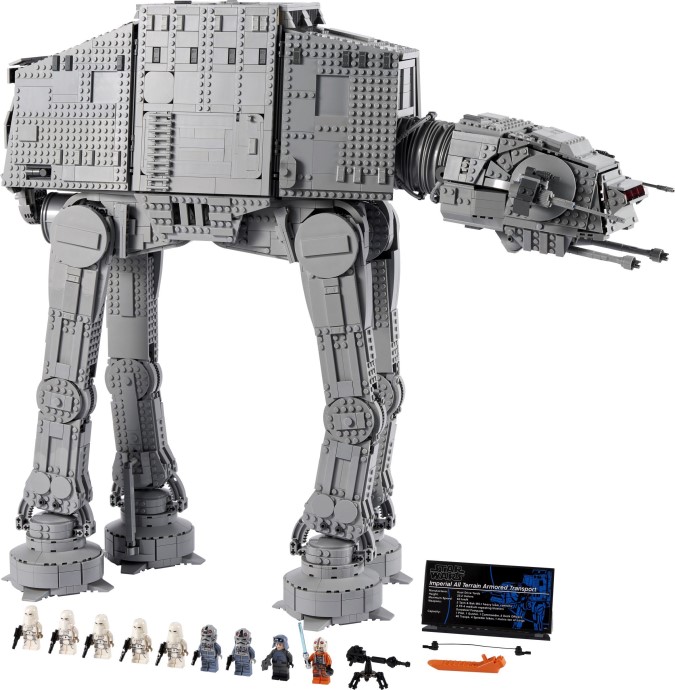
Every Star Wars fan carries a mental image of the AT-AT, and it is almost never a static one. It is the walker striding across the Hoth snowfield, legs swinging, head sweeping, the whole thing radiating the slow inevitability of Imperial power. That is the bar this set had to clear, and the reason so many earlier LEGO attempts felt like disappointments. A brick model that only stands there is a diorama prop. A brick model that actually poses is the machine from the film. The 75313 is the first mass-release AT-AT where the engineering genuinely delivers the second thing, and that single fact reframes the entire set. This is not a big grey box on four legs. It is a poseable Imperial war machine that happens to be built from 6,785 pieces.
What surprised me most is how the size sneaks up on you. On the box it looks manageable. Assembled, at roughly 62cm tall, it looms. It is one of the few sets in my collection that changes the character of the room it sits in, and the first time you crouch to eye level with the head you understand exactly why Rebel troops on Hoth looked so thoroughly outmatched. Before you commit, be honest about two things: whether you have the shelf real estate for something this tall and deep, and whether you want a display piece you will genuinely want to reposition from time to time. If the answer to both is yes, this is one of the most satisfying builds the Star Wars line has produced.
The AT-AT is a UCS set, and the build reflects the pedigree. At 6,785 pieces you are looking at a substantial multi-session project, somewhere in the range of 12 to 18 hours depending on pace, and the pacing is deliberately front-loaded with structure. The early bags are all about the internal skeleton, and this is where the set quietly announces its ambition. You are not building a hollow shell that gets skinned in grey plates. You are building a genuine load-bearing frame, because everything that follows depends on it holding several kilograms of walker off the ground on four articulated legs.
The legs are the heart of the experience. Each one is built as its own engineering exercise, combining Technic framing, friction joints, and a locking geometry that lets the walker hold a mid-stride pose without sagging or collapsing. Building the first leg is a genuine puzzle. Building the fourth is a small victory lap, because by then you understand the system and you can feel how the tolerances were tuned. This is the moment the set stops being a big Star Wars model and becomes a lesson in how to make brick support serious weight while still allowing movement.
The body and head sessions are the reward. After the discipline of the frame and legs, the upper hull opens up into detail work: the side panels that hinge open to reveal the troop compartment, the chin guns, the neck articulation, and the command head with its distinctive slab-sided profile. The troop bay is a highlight, a genuine interior space engineered to hold up to 40 minifigures, and building it out gives the whole model a sense of function rather than decoration.
The instruction manual is UCS-standard, which is to say excellent. Clear bag sequencing, sensible sub-assembly grouping, and a build order that keeps the model stable at every stage so you are never wrestling a top-heavy structure. It is a long build, but it never feels like padding. Every session earns its hours.
The standout technique here is the leg articulation, and it is a legitimate feat of consumer LEGO engineering. Supporting a model this heavy on four poseable legs, with joints that hold their angle under load, is a problem that has defeated smaller AT-AT sets for years. The 75313 solves it with a combination of Technic bracing, carefully placed friction elements, and a foot geometry that spreads weight without wobble. Study how the hip and knee joints are constructed and you come away with a transferable understanding of how to build any large poseable model that needs to stay put once posed.
Beyond the legs, the set is a catalog of large-scale hull techniques. The sloped armor panels use bracket-and-tile systems to create the AT-AT's angular, riveted-steel look at scale. The opening body panels demonstrate a clean hinge-and-latch approach that keeps access easy without leaving unsightly gaps in the exterior profile. The head assembly is a compact study in compound angles, capturing the walker's blocky command module and its recessed viewport in a way that reads correctly from every angle.
For MOC builders, the real education is structural. This is not a set about clever greebling or fancy SNOT curves. It is about load paths, rigidity, and articulated support at scale, which is exactly the knowledge you need for large mechs, vehicles, and any display model with moving parts. There are few better teachers in the official catalog for that specific discipline.
Nearly 6,800 pieces in a palette dominated by light bluish grey, dark bluish grey, and black, which is to say this is one of the best grey parts hauls you can buy in a single box. If you build in the Star Wars, sci-fi, or military-vehicle space, the sheer volume of grey plates, slopes, brackets, and Technic elements here is a serious foundational reserve.
The Technic content is the quietly valuable part of this haul. The leg engineering consumes a large quantity of beams, connectors, pins, and friction elements, and those are exactly the parts that are tedious and expensive to source individually on the secondary market. Anyone building large articulated MOCs will recognize the value of a single box that delivers this many structural Technic pieces in one go.
The set also includes a genuinely useful minifigure roster: Luke Skywalker, General Veers, AT-AT drivers, and snowtroopers, along with a pair of speeder bikes for the Hoth-battle scene. The snowtroopers in particular are desirable figures, and the collection as a whole gives you the makings of a proper Battle of Hoth display straight out of the box.
Parting out a completed AT-AT would be a genuine crime given the display payoff, but the underlying element value, especially the Technic and grey architectural pieces, is strong enough that the parts justify themselves independently of the finished model.
At roughly 62cm tall, the AT-AT does not politely occupy a shelf. It commands a floor space or a dedicated surface, and it dominates whatever it shares a room with. This is a genuine centerpiece, the kind of model that becomes the first thing anyone comments on when they walk in. Height is the headline, but the depth of the stance matters too: the legs splay wide, so this is a set that needs footprint as much as it needs vertical clearance.
The display impact is exceptional because the silhouette is so instantly readable. From across a room you get the unmistakable Hoth walker profile, four legs planted, head lowered on its long neck. From midrange the paneling and greebling emerge. Up close, with the body panels hinged open, you get the troop compartment and its cargo of minifigures, which turns a static display into a scene with implied narrative.
The poseability is what elevates the display above almost any other set this size. You can plant it in a neutral standing stance, or you can commit to a dramatic mid-stride pose with one leg forward and the head sweeping to the side, and the joints will hold it there. That means the display is not fixed. You can re-stage it, and each configuration reads differently, which keeps a large permanent model from becoming visual wallpaper over time.
Lighting rewards this set enormously. Angle a warm light low and across the hull and the grey armor develops the cold, weathered-steel presence the walker has on screen. One practical caution: this is a heavy, top-supported model on articulated legs, so it wants a stable, level surface and a spot where it will not be jostled. Pose it once, place it deliberately, and let it stand.
As a UCS flagship, the AT-AT sits in the premium tier of the Star Wars line, and the value case rests on three pillars: the piece count, the engineering, and the display presence. On raw volume, nearly 6,800 pieces puts this among the largest Star Wars sets available, and the per-piece economics are competitive with its UCS siblings. But volume is the least interesting part of the value argument here.
The real value is the poseability. You are not paying for a big static model, you are paying for a genuinely articulated one, and that engineering is what separates this from every cheaper AT-AT that came before it. Factor in the Technic parts reserve and a strong minifigure roster, and the set earns its flagship positioning on substance rather than size alone.
As a UCS set, the AT-AT also carries the aftermarket profile typical of the line. Retired UCS Star Wars sets have a well-documented history of holding and often appreciating in value, which gives buyers the comfort that a flagship purchase is unlikely to depreciate the way a mainstream set might. If you want the walker, buying it while it is on shelves is the straightforward move. Sets of this scale and significance do not stay available forever, and the UCS line in particular has a habit of becoming harder to find once it retires.
The AT-AT is for the builder who has graduated past mainstream sets and wants a flagship project with real engineering meat on it. It assumes patience for a multi-session build, comfort with Technic framing, and the physical space to display something 62cm tall with a wide stance. This is not a beginner set, and it is not a casual gift. It is a committed builder's centerpiece.
It is squarely aimed at the Star Wars devotee who wants the definitive Hoth walker, the one that finally poses the way the machine does on screen. It is for the collector assembling a UCS shelf, where the AT-AT is one of the natural anchor pieces. And it is for the display-focused builder who values a model that can be re-staged, because the articulation keeps it feeling alive long after the build is done.
If you have the space, the patience, and the affection for the Empire's most iconic ground machine, the AT-AT earns every hour and every piece.
The AT-AT is a natural anchor for a Star Wars display, and it plays beautifully off other UCS flagships. The Millennium Falcon (75192) creates the definitive heroes-versus-Empire shelf, the Rebellion's fastest ship squared off against the Empire's heaviest walker. Pairing the two is the closest thing the LEGO catalog offers to a saga-in-brick centerpiece.
For a fuller Imperial theme, the Death Star completes the trio, giving you the Empire's ground, air, and orbital might in a single display. The scale contrast between the towering walker and the spherical battle station makes for a striking arrangement that tells the story of Imperial reach without a single word of context needed.
Track the current market value of the AT-AT and compare it against other UCS Star Wars flagships on GameSetBrick.
- Genuinely poseable legs that hold a mid-stride stance under real weight
- Roughly 62cm of commanding, room-dominating display presence
- Opening body panels reveal a troop bay that holds up to 40 minifigures
- Excellent grey and Technic parts reserve for sci-fi and MOC builders
- Strong minifigure roster with snowtroopers, Veers, Luke, and speeder bikes
- UCS aftermarket profile that historically holds value after retirement
- Premium flagship pricing that demands real commitment
- Needs a large, level footprint, not just a tall shelf
- Heavy, top-supported model that wants an undisturbed spot
- Build complexity is not suited to novice builders
- LEGO Millennium Falcon Review - The Rebellion's flagship and the AT-AT's natural rival
- LEGO Death Star Review - Complete the Imperial display trio
- LEGO Investing 101 - How UCS sets like the AT-AT hold value after retirement
- Retiring Sets Tracker - Which flagship sets are leaving shelves in 2026
- All Reviews - Browse every set The Earl has put through its paces
The thing I did not expect was how much the internal frame changes your respect for the model. From the outside the AT-AT looks like a slab-sided grey machine, but the load-bearing skeleton you build first is a genuine piece of engineering, and once you understand how the weight travels from the body down through the hip joints and into the feet, the whole model reads differently. You stop seeing a Star Wars display piece and start seeing a solved structural problem. That is a kind of understanding most sets this size never bother to teach.
The other surprise was the troop compartment. It would have been easy for LEGO to make the opening panels a token gesture, a shallow gap with a couple of studs inside. Instead the bay is a real functional space engineered to hold up to 40 minifigures, and building it out gives the walker a sense of purpose that a sealed hull never would. It turns the model from a statue into a vehicle with a job to do, and that shift in character is worth far more than the handful of extra pieces it cost.
Track it in your vault on GameSetBrick - our free collection app. Log your condition, price paid, and watch the real-time market value.
Track in Your Vault →Save it to your wishlist on GameSetBrick. Share your list with friends and family - every set has a buy button so gift givers know exactly where to go.
Add to Wishlist → GameSetBrick is a free app by The Earl of Bricks. See all features. Scan it. Track it. Trade it.