Is the LEGO Donkey Kong Arcade Worth Buying?
7.72/10. Worth buying. The 1981 cabinet that gave gaming its first jump arrives as a 1,367-piece homage with a working barrel lever, a joystick-driven Jumpman, and 21 barrels that actually roll down the girders.

Some sets are asked to look good on a shelf, and a rare few are asked to actually do the thing they depict. The Donkey Kong Arcade is firmly the second kind, and it made me grin before I had finished the first bag. This is a homage to the 1981 cabinet that gave gaming its first proper jump, and rather than settle for a static replica of the machine, LEGO built the machine that plays. Pull the lever and a barrel rolls. Nudge the joystick and Jumpman shuffles along the girder. It is the sort of set that ends up on your desk not because it is pretty, though it is, but because you cannot walk past it without having a go.
What wins me over is the discipline behind the whimsy. It would have been easy to fake all this with stickers and a printed screen and call it a day. Instead there is a genuine mechanism inside the cabinet cycling 21 barrels in a continuous loop, and a small trick where the blue barrels are weighted to roll faster than the orange ones, which is exactly the kind of unnecessary, delightful detail that tells you the designers cared. At 1,367 pieces this is a proper adult build, and it earns its place by remembering that the original was, above all, fun.
At 1,367 pieces the Donkey Kong Arcade is a substantial afternoon build, and it is more interesting than most sets this size because a good chunk of the work is mechanism rather than facade. You are not just cladding a box in decorative brick, you are assembling a working toy hidden inside a cabinet, and that changes the rhythm of the assembly in a welcome way.
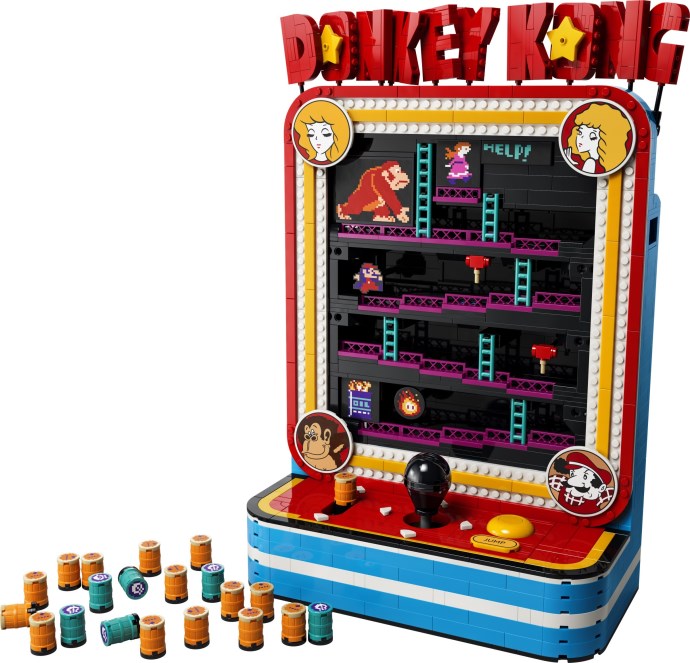
The heart of the build is the barrel loop. The model routes 21 barrels through a continuous internal circuit so that the lever on the front can release them one at a time, as though Donkey Kong himself were hurling them down the girders. Getting that path assembled and running cleanly is the satisfying engineering centrepiece of the box, and it is the sort of thing you test as you go, watching a barrel travel the course for the first time.
The control side is just as clever. Jumpman rides the lower girder and is driven by the cabinet's joystick, while a separate button triggers his leap so you can time him over an incoming barrel. Wiring those two inputs to their movements is where the build feels most like putting a little arcade machine together, and it rewards a careful builder who takes the time to seat the linkages squarely.
Around the mechanism you build up the classic tableau: the angled red girders, the ladders between levels, the hammer, and the scaffold framework that made the original screen so readable. It is a layered assembly that stacks the playfield upward, and the cabinet shell then closes it all in. It never drags, because the payoff of testing the lever and joystick keeps pulling you forward. Budget an unhurried afternoon and expect to stop and play with it more than once before you are done.
Finished, this has real presence. It stands over 39 cm tall, a genuine centrepiece rather than a desk trinket, and the silhouette is instantly readable to anyone who has ever fed a coin into an upright cabinet. The measured footprint of 39 x 27 x 15 cm means it holds its own on a shelf without demanding a whole one to itself.
The front of the cabinet recreates the famous playfield in brick: the leaning red girders climbing the screen, the ladders, and the three characters staged in their eternal standoff. Jumpman waits at the bottom, Donkey Kong looms up top ready to fling barrels, and Lady is stranded above, exactly the frozen drama that a generation of players remember. Rendering that composition in three dimensions, rather than as a flat printed panel, is what gives the model its charm.
What lifts it from replica to conversation piece is that the display is also the play feature. You can leave it posed as a still homage or actually run the barrels and move Jumpman for anyone who wanders past, and that dual nature makes it a far livelier shelf-mate than a static bust or vehicle. It photographs beautifully from straight on, where the girder geometry and the character staging read cleanly, and the retro colour palette pops under a display light.
It is styled as playful decor for an entertainment room or home office, and that is exactly where it lands. This is a set that starts conversations, invites a quick go, and quietly signals that the person who built it knows where the whole industry began.
At 1,367 pieces this is a fair haul, and the mix is unusual in a genuinely useful way. Because so much of the build is a working mechanism, the box is heavy on the functional elements, the linkages, angled supports and small technical pieces, that drive the barrel loop and the joystick movement. For anyone who tinkers with their own kinetic builds, that is a more interesting donor palette than yet another wall of standard plates.
The 21 barrels themselves are a fun bulk element, and the red girder and ladder framework gives you a stack of angled structural pieces useful for anyone recreating arcade or industrial scenery. The three characters are unique to this set, which gives collectors a reason to keep them staged with the cabinet rather than raiding them for other builds.
On lasting appeal, licensed sets tied to genuinely foundational subjects tend to hold interest better than passing tie-ins, and there are few subjects more foundational to gaming than the machine that invented the platformer. A working homage to the 1981 original is the kind of release that stays meaningful long after its wave has moved on. Our LEGO Investing 101 guide walks through why landmark-subject and pop-culture-milestone sets tend to age the way they do.
Donkey Kong reached arcades in 1981, released in Japan on 9 July, and it arrived out of desperation rather than grand ambition. Nintendo had a warehouse of unsold Radar Scope cabinets after that game flopped in North America, and the job of turning them into something people would actually play fell to a young, first-time game designer named Shigeru Miyamoto, handed the project by company president Hiroshi Yamauchi. It was a rescue mission, and it changed everything.
Miyamoto built a game around a simple, legible story: a carpenter named Jumpman climbing a construction site to save a woman, Pauline, known as Lady in Japan, from a giant ape who kept rolling barrels down at him. Crucially, Jumpman could jump, and the player had to leap the gaps and the incoming barrels while climbing ladders between the girders, with a hammer to smash obstacles along the way. That single mechanic made Donkey Kong the first platform game to feature jumping, and it laid down the template that thousands of games would follow.
The impact was enormous. The game revived Nintendo's fortunes almost overnight and introduced three names that would dominate the medium for decades: Nintendo itself, Shigeru Miyamoto, and the character then called Jumpman, who would soon be renamed Mario and become the most recognisable figure in gaming. A homage that not only depicts that cabinet but recreates the barrel-and-jump loop that started it all is honouring a genuine turning point, the moment the arcade learned to tell a story and the platformer was born.
Retro gaming enthusiasts are the obvious core audience, and for anyone who grew up feeding coins into an upright Donkey Kong cabinet this is an easy, nostalgic yes. The working lever, the joystick-driven Jumpman and the rolling barrels turn a memory into something you can actually operate on your desk.
Adult display builders who want variety beyond buildings and vehicles will value it as a centrepiece that does something. It sits comfortably alongside more architectural sets while telling a completely different story, and its play features give it more to offer than a static ornament ever could.
It is also a strong pick for the Nintendo and Super Mario collector building out a shelf of milestones, and a genuinely good gift for the gamer who has everything, precisely because it celebrates where their hobby began. As a set that invites everyone who passes to have a go, it earns its keep in a shared space rather than hiding in a cabinet.
The Donkey Kong Arcade pairs naturally with the other pillars of retro gaming. Set beside the Sega Genesis Console (40926), you get a two-piece story of the era, the arcade cabinet that started the platformer and the home console that carried the torch into the living room.
For a display built around the coin-op cabinet itself, the Arcade Pinball Machine (11374) makes an ideal shelf-mate, two working amusement machines from the golden age of the arcade standing side by side. It is a pairing that turns a corner of the room into a small barcade.
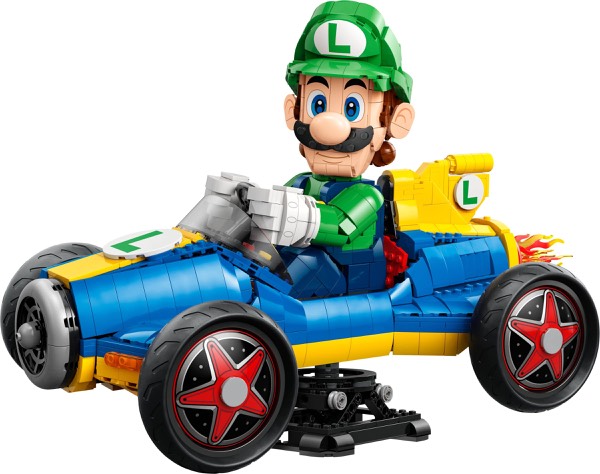
And for a run through the Nintendo bloodline, the Mario Kart Luigi Mach 8 (72050) brings the modern face of the same Super Mario universe alongside its 1981 origin, showing just how far the plumber has travelled from a construction-site carpenter dodging barrels.
Pros
- Genuinely works: lever releases barrels, joystick and button move and jump Jumpman
- Internal mechanism cycles 21 barrels in a continuous loop
- Weighted blue barrels roll faster than orange ones, a lovely bonus of detail
- Instantly readable cabinet silhouette at a real 39 cm centrepiece scale
- Girders, ladders, hammer and three unique characters recreate the classic playfield
- Honours a genuine turning point, the first platform game to feature jumping
Cons
- Mechanism-heavy parts have limited use outside kinetic builds
- Three characters unique to the set are best kept staged with the cabinet
- Novelty of the play feature may fade faster than a pure display piece for some
- A single-scene subject rather than a sprawling, varied build
The Donkey Kong Arcade is one of the more joyful adult sets in the current range, precisely because LEGO refused to fake the thing that made the original matter. At 1,367 pieces it delivers a substantial cabinet with a properly engineered barrel loop, a joystick-driven Jumpman, a jump button, and the girders, ladders and hammer that made the 1981 screen a legend, all wrapped in a silhouette anyone recognises.
It takes EARL APPROVED status comfortably on the strength of its working play features, its display presence, and the sheer weight of the story behind it, held just shy of the very top tier only by a mechanism-focused parts mix and a single-scene subject that some builders will find narrower than a larger set.
Available now, and an easy recommendation for any retro gamer, Nintendo collector, or builder who wants a shelf piece that does something. Forty-odd years on, the barrels still roll, and this little cabinet still knows exactly why that first jump mattered.
- Sega Genesis Console Review - The home console that carried retro gaming forward, a natural shelf-mate
- Arcade Pinball Machine Review - A second working coin-op cabinet to build your barcade around
- Mario Kart Luigi Mach 8 Review - The modern face of the same Super Mario universe
- LEGO Investing 101 - Why landmark-subject and pop-culture sets tend to age well
Track it in your vault on GameSetBrick - our free collection app. Log your condition, price paid, and watch the real-time market value.
Track in Your Vault →Save it to your wishlist on GameSetBrick. Share your list with friends and family - every set has a buy button so gift givers know exactly where to go.
Add to Wishlist → GameSetBrick is a free app by The Earl of Bricks. See all features. Scan it. Track it. Trade it.