Is the LEGO Gustav Klimt - The Kiss Worth Buying?
8.6/10. Worth buying. Klimt's shimmering Golden Period masterpiece rebuilt at 4,000 pieces, the largest LEGO Art masterpiece set yet, complete with a brick-built frame and gold and silver tilework.
Comparing your options? See where it lands in our best LEGO Art sets.

There are paintings that translate into brick because they were already halfway there, and Klimt's The Kiss is the purest example I can think of. Klimt built his 1908 masterpiece out of gold leaf, patterned rectangles and swirling circular motifs, a canvas that already reads like a mosaic before anyone hands you a numbered bag. So when LEGO announced a 4,000-piece Art set of it, my usual eyebrow stayed down. This is not a photograph being forced into studs. It is a mosaic being rebuilt as a mosaic, which is exactly the job LEGO tiles were born to do.
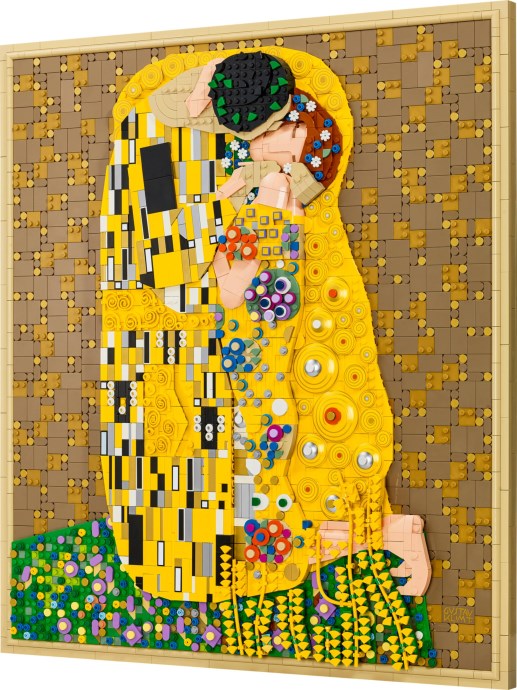
And LEGO went big. At 4,000 pieces this is the largest LEGO Art masterpiece set the company has released, setting aside the World Map, and it finishes as a piece of wall art standing taller than most framed prints you would hang next to it. Master Model Designer Milan Madge has treated the gold not as a printed shortcut but as a genuine surface of gold and silver tiles, and the result is the closest LEGO has come to putting shimmer into plastic. This one earns the shelf, or rather the wall.
At 4,000 pieces spread across 33 numbered bags, 456 pages and 668 steps, this is a genuine multi-evening commitment rather than a weekend afternoon. What keeps it from becoming a slog is the way the build is structured. From the very first bag you are constructing the brick-built frame at the same time as the image, and that dual assembly continues most of the way through, so you are never simply laying identical tiles for hours on end the way some mosaic sets ask of you.
The techniques are where Madge earns the designer credit. Rather than a flat field of studs, the surface is layered: bricks are stacked with brackets attached sideways to the baseplates, and slots are built into the composition that later receive sliding brick-built shapes held in place by interlocking pieces. That approach gives Klimt's robes and the golden cloak real physical depth, so the finished panel is textured and three-dimensional instead of a smooth mural.
The gold is the signature moment of the build. Klimt's original glows because of actual metal leaf, and LEGO recreates that glow with gold and silver tiles and modified plates, plus 1x1 studs and 1x1 round tiles distributed across the couple's robes and the surrounding field. Watching the shimmer accumulate row by row as you place those metallic elements is the most satisfying stretch of the whole project, and it is where the set most clearly stops being a toy and starts being a decorative object.
A word of honesty on difficulty: this is not a first LEGO Art set. The volume of small elements, the layered slotting and the sheer page count reward a builder who already knows the theme's rhythm. Developed alongside Vienna's Belvedere Museum, the set comes with a companion podcast featuring Madge and Belvedere curator Stephanie Auer, on LEGO.com, Spotify and YouTube, which is a pleasant companion for the longer placement sessions.
Finished, The Kiss measures roughly 60 cm high by 54 cm wide and about 4 cm deep, which makes it substantial wall art by any standard and the largest canvas the Art line has produced short of the World Map. It is built portrait orientation, tall rather than wide, which suits Klimt's vertical embrace and gives it a presence that most horizontal LEGO mosaics lack. The brick-built frame is completed as part of the set itself, so there is no external framing to source and no display stand to buy separately.
Because the frame is integral to the build, designed to hang flush against a wall rather than perch on a shelf, the piece reads as a single finished artwork the moment it comes off the table, and it holds its own hung beside conventional framed prints in a way very few construction sets can claim.
Where the set truly delivers is light. The gold and silver tilework catches ambient and directed light at different angles thanks to the raised, layered surface, so the piece genuinely shifts as you move past it, the same trick the metal-leaf original plays in its Belvedere gallery. From across a room the elements dissolve into Klimt's embracing couple and their shimmering cloak; step in close and the tiles, plates and slotted shapes resolve into the LEGO detail work. That dual-distance effect is the reward for the parts count. There are no minifigures, and there should not be: this is decor, not a playset, and the design commits fully to that identity.
Four thousand pieces is a serious haul, and the mix here is more interesting than the wall of 1x1 rounds some mosaic sets deliver. You get a broad spread of gold and silver tiles, modified plates, 1x1 studs and round tiles, plus the structural bricks, brackets and baseplates that build the layered surface and the frame. For a builder who works in decorative or ornamental MOCs, that metallic element pool is unusually valuable, because gold and silver parts in quantity are exactly what those builds tend to run short of.
The sideways bracket construction and the slotting technique are worth studying in their own right. Anyone building textured wall pieces, ornate architecture or their own mosaics can lift ideas directly from how Madge layers and locks these shapes together, and the frame system is reusable across any Art-format build you might attempt yourself.
As the flagship of the Art masterpiece line, this sits at the premium end, but as a multi-evening build plus a large, gallery-ready display piece plus a museum-backed collaboration, it justifies its standing. Klimt's The Kiss is also one of the most reproduced images in all of Western art, and sets tied to blue-chip cultural icons tend to hold interest the way passing trends do not, a pattern our LEGO Investing 101 guide walks through in detail.
Gustav Klimt painted The Kiss in 1907 and 1908, at the very height of what art historians call his Golden Period. It is oil on canvas, but its glow comes from the gold leaf, silver and platinum foil Klimt applied across the surface, techniques he drew from Byzantine mosaics he had studied in Ravenna and from the flattened patterning of Japanese prints. The result is a shimmering, near-abstract field in which a couple kneels in a tight embrace, wrapped together in a single golden cloak.
Look closely and Klimt's design logic appears in the patterning itself: the man's robe is decorated with hard angular rectangles, the woman's with soft circular motifs, the two vocabularies interlocking as the figures do. It is a masterpiece of the Vienna Secession, the Austrian strand of Art Nouveau that Klimt co-founded in 1897 in open revolt against the city's conservative art establishment, and it is widely regarded as the defining work of that movement and of Klimt's entire career.
The painting has lived at the Belvedere in Vienna for more than a century, where it hangs as the museum's most famous holding, which makes the Belvedere's involvement in this release a fitting loop to close. More than a hundred years on, The Kiss remains one of the most reproduced images in Western art, precisely what makes it such a natural subject for LEGO's most ambitious mosaic yet.
Art lovers who build are the obvious core audience, and this set serves them with real cultural seriousness. If you visit museums, if Klimt already hangs as a print somewhere in your home, if the Belvedere is on your Vienna list, this is a set designed with you squarely in mind. The museum collaboration and the companion podcast are not marketing dressing; they reflect a genuine attempt to make an object that sits honestly at the meeting point of fine art and building.
Experienced LEGO Art builders chasing a technique challenge are the second natural fit. The layered surface, the sideways bracket work and the slotting shapes are a clear step up from a flat stud mosaic, and the metallic tilework demands patience and precision. This is not a switch-your-brain-off placement build; it asks for attention and rewards it.
It also makes an exceptional gift for the art enthusiast or design-minded person who would never buy themselves a LEGO set but would happily hang Klimt on their wall. What it is not is a beginner's entry into the theme. If this would be someone's first LEGO Art set, point them at a smaller mosaic first and let them graduate to this one.
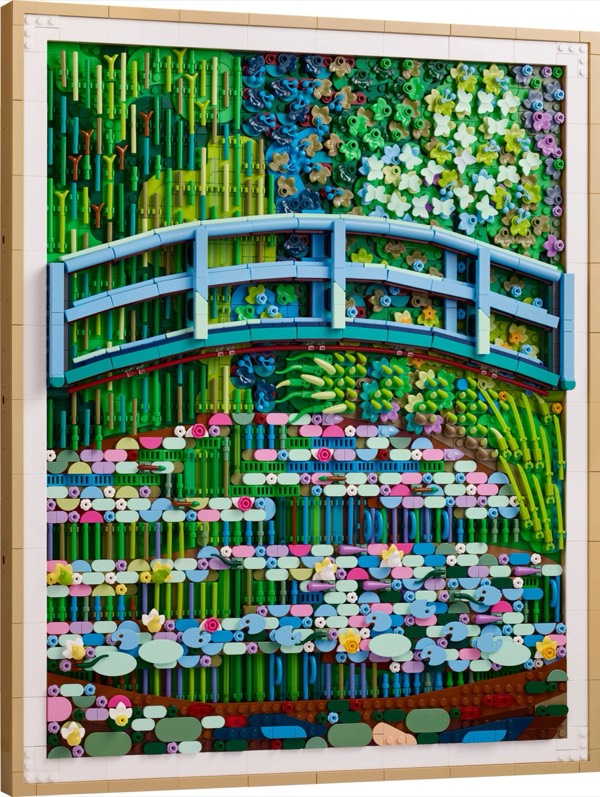
The Kiss anchors a fine-art wall alongside the other painting sets in the Art masterpiece line, and it pairs especially naturally with the Monet Water Lilies (31220), giving you two museum-grade European masterpieces rendered in brick, one all shimmering gold and the other all diffuse Impressionist light.
For a turn-of-the-century grouping, it sits beautifully next to the Van Gogh Sunflowers (31215), another richly textured post-Impressionist icon, letting a wall trace European painting across a single decisive generation.
And for the boldest contrast, hang it near the three-dimensional Starry Night (21333), where Van Gogh's swirling night sky and Klimt's golden embrace make an unmissable pairing of two of the most reproduced images in art, each solving the mosaic problem in a completely different way.
Pros
- Largest LEGO Art masterpiece set yet at 4,000 pieces
- Gold and silver tilework genuinely shimmers as light moves across it
- Layered, slotted surface gives Klimt's robes real physical depth
- Brick-built frame is completed as part of the set, ready to hang
- Belvedere Museum collaboration with a companion curator podcast
- Subject is one of the most recognised images in all of Western art
Cons
- Premium flagship pricing at the top of the Art line
- Long build at 668 steps across 33 bags, a multi-evening commitment
- Not recommended as a first LEGO Art set
- Needs substantial dedicated wall space to display well
Gustav Klimt - The Kiss is the most convincing argument LEGO Art has made for treating brick as a serious medium for reproducing a painting, precisely because the source was already a mosaic. The gold and silver tilework catches the light the way Klimt's metal leaf does, the layered slotting techniques give the surface genuine depth, and at 4,000 pieces it finishes as the largest and most impressive canvas the line has produced.
It takes EARL APPROVED status comfortably, carried by its display presence, its inventive construction and the cultural weight of the Belvedere collaboration. It is held just shy of the very top only by its flagship pricing and the fact that its length and difficulty make it a poor choice for anyone new to the theme.
Available now through LEGO Insiders Early Access, and an easy recommendation for any art lover with the wall space and the patience for a proper build. Klimt made The Kiss to shimmer. This set, remarkably, shimmers too.
- Monet Water Lilies Review - The other museum-grade masterpiece in the Art line
- Van Gogh Sunflowers Review - A richly textured post-Impressionist icon in brick
- Starry Night Review - Van Gogh's swirling night sky as a 3D LEGO build
- Best LEGO Art Sets - Where The Kiss lands against the full Art range
- LEGO Investing 101 - Why sets tied to blue-chip cultural icons tend to age well
Track it in your vault on GameSetBrick - our free collection app. Log your condition, price paid, and watch the real-time market value.
Track in Your Vault →Save it to your wishlist on GameSetBrick. Share your list with friends and family - every set has a buy button so gift givers know exactly where to go.
Add to Wishlist → GameSetBrick is a free app by The Earl of Bricks. See all features. Scan it. Track it. Trade it.