Is the LEGO Hubble Space Telescope Worth Buying?
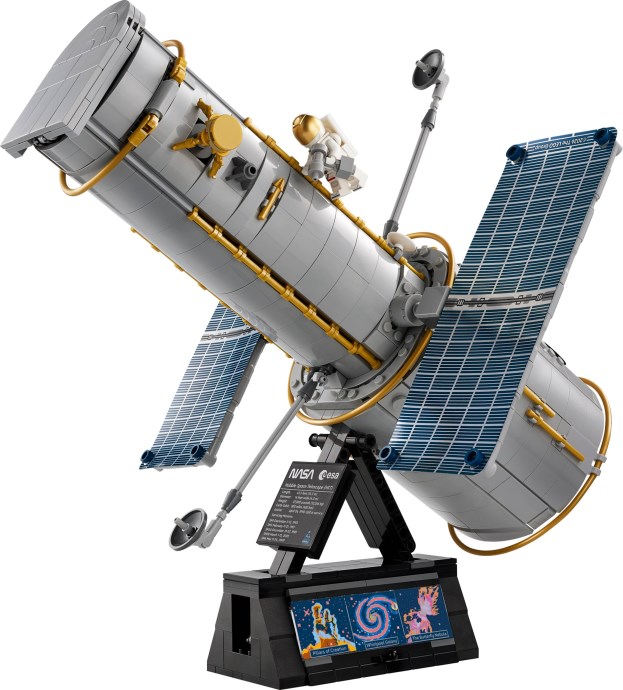
7.74/10. Worth buying. Thirty-five years after Discovery lifted it into orbit, the most important telescope ever built arrives as a 1,252-piece Icons display model with posable solar arrays, an opening aperture, and a stand honouring its greatest images.

Some subjects LEGO chooses because they look good on a shelf, and some it chooses because they genuinely changed how we see the universe. Hubble is squarely the second kind. This is the instrument that gave us the Pillars of Creation, that stared into a patch of empty sky for days and came back with thousands of galaxies, and that rewrote the age of the cosmos from the comfort of low Earth orbit. So when an Icons box turns up with that silver tube and those gold solar wings on the lid, I do not roll my eyes the way I might at yet another supercar. I lean in. This one earns the reverence.
What pleases me most is that LEGO treated it as a serious anniversary piece rather than a novelty. It is thirty-five years since the Space Shuttle Discovery carried Hubble aloft, and the model leans into that legacy with an opening aperture, posable arrays, and a display stand that names the images that made the telescope famous. It is a build about a machine, and it never forgets that the machine did something extraordinary.
At 1,252 pieces this is a proper adult Icons build, marked 18 plus, and it takes the sensible engineering-first route the theme does well. You start with the internal skeleton of the telescope, the long structural core that everything else hangs from, and then work outward through the instrument bay, the mirror assemblies, and finally the outer skin of the famous silver tube.
The optical heart of the build is the part I enjoyed most. The model recreates the primary and secondary mirror layout inside the tube, and building that instrument section gives you a real sense of how the light path actually worked: down the barrel, off the primary, back to the secondary, and into the science instruments. It is the sort of detail you only fully appreciate once you have assembled it with your own hands.
The aperture door is the signature moving feature. The end of the telescope opens like the real light shield, so you can display Hubble sealed for transit or open and observing. It is a simple mechanism, but it is exactly the kind of interactive touch that lifts a static display model, and it gives you a genuine choice in how the finished piece sits on the shelf.
Where the build asks for patience is the outer barrel and the solar arrays. Wrapping the cylindrical body in smooth curved panels is repetitive by nature, and the two large solar wings are built as matched pairs, so you do a fair amount of the same work twice. It never becomes a chore, but this is a set where the drama is front-loaded into the optics and the pacing softens toward the end. Budget an unhurried afternoon.
Finished, Hubble has real presence. It stands roughly 32 cm long on its stand, a genuine centrepiece rather than a shelf ornament, and the silhouette is instantly readable: the long silver cylinder, the twin gold solar wings, and the dish antennas reaching out on their booms. This is one of the most recognisable machines humanity has ever put in orbit, and the model captures it cleanly from across the room.
The posable elements are what make it a joy to pose rather than just park. The solar arrays and the high-gain antennas move, so you can splay the wings wide for the classic deployed-in-orbit look or fold things tighter for a more compact stance. Combined with the opening aperture, you get more display flexibility than most pure display models offer.
The stand and plaque are the thoughtful finishing touch. Rather than a bare cradle, the display base celebrates three of Hubble's most famous observations by name, the Pillars of Creation, galaxy NGC 2525, and the Butterfly Nebula, turning the model into a small tribute to what the telescope actually saw. It is a detail that gives the piece a story, and it photographs beautifully under a display light where the silver and gold catch the highlights.
A single astronaut minifigure is included, and here it earns its place: it stands in for the shuttle crews who deployed and serviced Hubble across five missions, and it gives the model a sense of scale that a telescope floating alone would lack. It is a small crew of one, but it is the right one.
Twelve hundred and fifty-two pieces for a set at this scale is a fair haul, and the mix is unusual in a useful way. The curved panels that form the barrel, the gold and silver plating for the solar wings, and the technical greebling of the instrument bay all have obvious reuse for anyone building spacecraft, satellites, or sci-fi hardware in their own creations.
The build leans on structure and cylinder-wrapping technique rather than exotic printed elements, which keeps the parts genuinely reusable rather than locking them to one licensed livery. If you build in microscale or midscale space, this box is a quietly excellent donor of the right shapes and finishes.
On lasting appeal, anniversary Icons sets tied to genuinely historic subjects tend to hold interest better than passing tie-ins, and there are few subjects more historic than Hubble. A 35th-anniversary model of the most important telescope ever flown is the kind of release that stays meaningful long after the wave it launched in. Our LEGO Investing 101 guide walks through why anniversary and landmark-subject sets tend to age the way they do.
The Hubble Space Telescope was carried into orbit on 24 April 1990 aboard the Space Shuttle Discovery, on mission STS-31, a joint project of NASA and the European Space Agency named after the astronomer Edwin Hubble. The idea was radical: put a large optical telescope above the atmosphere entirely, escaping the blur and shimmer that limits every observatory on the ground, and let it see the universe with a clarity nothing on Earth could match.
It very nearly failed. Soon after launch, engineers discovered the primary mirror had been ground to the wrong shape, a flaw called spherical aberration that left the first images frustratingly soft. The fix came in 1993, when a shuttle crew installed corrective optics in one of the boldest repair jobs ever attempted in space, and Hubble's vision snapped into focus. Four further servicing missions across the following years upgraded its instruments and kept it alive, making it the only space telescope ever designed to be serviced by astronauts.
What followed reshaped astronomy. Hubble delivered the Pillars of Creation, the Deep Field and Ultra Deep Field that revealed thousands of galaxies in a sliver of apparently empty sky, and the observations that helped pin down the age and expansion of the universe. Thirty-five years on it is still working, still returning science, and still one of the most productive scientific instruments ever built. A model that honours it is a model of something that genuinely mattered.
Space and science enthusiasts are the obvious core audience, and for anyone who grew up on Hubble's images this is an easy, sentimental yes. The named observations on the plaque and the 35th-anniversary framing make it feel like a considered tribute rather than a box-ticking licensed release.
Adult display builders who want variety beyond buildings and vehicles will value it as a genuine centrepiece. It sits comfortably alongside the more architectural Icons sets while telling a completely different story, and its posable arrays and opening aperture give it more to do than a static ornament.
It is also a strong gift for the STEM-minded, the sort of set that starts conversations about how the light path works or why the mirror had to be fixed in orbit. As a way into midscale space building, the parts palette is a bonus that outlasts the first display.
Hubble pairs naturally with the crewed hardware that made it possible. Set beside the NASA Apollo Saturn V (92176), you get a two-piece story of human spaceflight, the rocket that took people to the Moon and the observatory that let us see beyond it.
For a display about what Hubble actually revealed, the The Milky Way Galaxy (31212) makes an ideal backdrop, the instrument on one side and the cosmos it studies on the other. It is a pairing that turns a shelf into a small planetarium.
And for a lighter counterpoint, the Tintin Moon Rocket (21367) brings a splash of adventure-era space romance next to Hubble's precision engineering, showing how far the dream of leaving Earth has travelled from fiction to working science.
Pros
- Instantly recognisable Hubble silhouette at a genuine centrepiece scale
- Opening aperture door and posable solar arrays add real display flexibility
- Instrument bay recreates the primary and secondary mirror light path
- Display stand and plaque celebrate three of Hubble's most famous images
- Astronaut minifigure grounds the model in the servicing-mission story
- Honours a genuinely historic subject on its 35th anniversary
Cons
- Outer barrel panelling is repetitive by nature
- Matched solar arrays mean building similar assemblies twice
- Pacing softens toward the end once the optics are done
- A single, largely static form compared with more theatrical Icons builds
The Hubble Space Telescope is one of the more meaningful display sets in the current Icons range, precisely because LEGO respected the significance of the subject. At 1,252 pieces it delivers a substantial centrepiece with a properly engineered light path, an opening aperture, posable arrays, and a stand that remembers what the telescope actually achieved.
It takes EARL APPROVED status comfortably on the strength of its display presence, its interactive touches, and the sheer weight of the story behind it, held just shy of the very top tier only by the repetitive barrel-and-array stretch that comes with modelling a cylinder wrapped in solar wings.
Available now, and an easy recommendation for any space enthusiast, science-minded builder, or collector who wants a shelf piece that means something. Thirty-five years on, Hubble still commands the room, and so does the model of it.
- NASA Apollo Saturn V Review - The rocket that opened the space age, a natural shelf-mate for Hubble
- The Milky Way Galaxy Review - The cosmos Hubble was built to study, as a wall-mounted backdrop
- Tintin Moon Rocket Review - Adventure-era space romance next to Hubble's precision
- LEGO Investing 101 - Why anniversary and landmark-subject sets tend to age well
Track it in your vault on GameSetBrick - our free collection app. Log your condition, price paid, and watch the real-time market value.
Track in Your Vault →Save it to your wishlist on GameSetBrick. Share your list with friends and family - every set has a buy button so gift givers know exactly where to go.
Add to Wishlist → GameSetBrick is a free app by The Earl of Bricks. See all features. Scan it. Track it. Trade it.