Is the LEGO Colosseum Worth Buying?
8.9/10. Worth buying. 9,036 pieces of repetitive, meditative arch-work that add up to the most convincing microscale ruin LEGO has ever made.

Let me be honest with you up front, because you will hear this everywhere and you should hear it here first: the Colosseum is repetitive. You will build the same tiered arch dozens of times. You will place the same tan and sand slopes in the same graduated pattern until your fingers know the sequence better than your eyes do. If that sentence makes you recoil, this set is not for you and I would rather you know that now than 3,000 pieces in. But if you read it and felt something loosen in your shoulders, if the idea of a long, rhythmic, almost hypnotic build sounds like a gift rather than a chore, then keep reading. This is one of the most quietly rewarding builds LEGO has ever engineered.
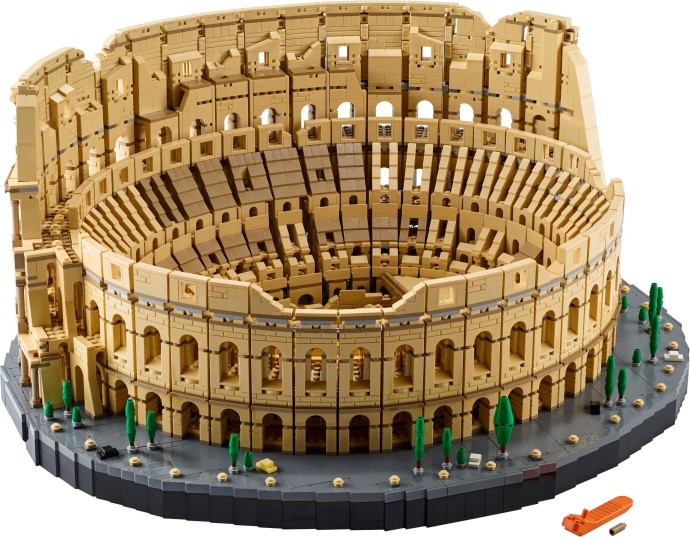
What the marketing led with in 2020 was the number. At 9,036 pieces this became the largest LEGO set ever produced at launch, dethroning the Millennium Falcon and briefly holding a record it would soon hand to the Titanic. But the piece count is the least interesting thing about it. The interesting thing is that LEGO used those pieces to build a ruin - a monument that is famous partly because it is broken. Getting a crumbling ellipse to read as convincingly weathered, in microscale, out of rigid plastic bricks, is a far harder problem than building a pristine tower. That is the achievement here, and it is why the Colosseum has aged into a landmark of its own.
The Colosseum is a build defined by its geometry. Almost everything on the amphitheater is elliptical, and an ellipse is the cruelest shape in LEGO because it has no clean right angles and no consistent curve radius. LEGO's solution is a segmented core - a ring of interlocking wedge sections that establish the oval footprint - onto which the tiered facade and interior seating are layered. You build the ground floor ellipse first, and once that foundation is locked in, the rest of the set is a patient exercise in stacking upward and outward.
Expect somewhere in the region of 15 to 20 hours across several sessions. This is not the longest of the giant sets, but it may be the most meditative. The construction is genuinely, unapologetically repetitive. The three exterior arcade levels - Doric, Ionic, and Corinthian, each with subtly different arch detailing - are each built from a run of near-identical arch modules repeated around the full circumference. You settle into a rhythm quickly. Place the columns, bridge the arches, add the cornice, rotate the model, do it again. Some builders describe this as tedious. I describe it as flow, the same way lap after lap around a familiar circuit stops being effort and starts being calm.
The interior is where the build earns its variety. The tiered seating bowl, the exposed hypogeum (the underground network of passages beneath the arena floor), and the partial arena decking all break up the exterior monotony. LEGO also builds the ruin deliberately: one section of the outer wall is complete and pristine, and it steps down progressively to a lower, "collapsed" section, mirroring how the real Colosseum stands today. Constructing that graduated decay is the single most satisfying stretch of the build, because you can feel the designers making an artistic choice rather than a structural one.
The instruction manual is clear and well-paced, with numbered bags that keep the enormous parts count manageable. My one caution: the repetition means it is easy to lose your place or miscount an arch run. Build in good light, count twice, and do not attempt the elliptical rings while tired. A single misplaced wedge early on cascades into a facade that will not close.
The headline technique is the elliptical construction, and it is worth studying even if you never intend to build a stadium. LEGO approximates a true ellipse using a series of straight and gently hinged segments that, at this scale and viewing distance, read as a smooth continuous oval. The transitions between segments are hidden inside the arch spacing, so the eye never catches the seams. For any MOC builder who has ever fought to make a curved wall look intentional rather than accidental, this set is a masterclass in disguising the joints.
The second technique on display is repetition-as-texture. The tiered arches are, individually, simple builds. But repeated 80 times around the structure, they create the dense, layered visual rhythm that makes the Colosseum instantly recognizable. This is microscale architecture done properly - not shrinking detail, but choosing which details carry the silhouette and repeating them with discipline. The graduated slopes on the seating bowl use a similar principle, stepping tan and sand elements to suggest tiers of stone benches without modeling every row.
The ruin detailing deserves its own mention. Achieving a convincing sense of weathered collapse means deliberately leaving things incomplete and using cheese slopes and small plates to imply broken masonry. It is a technique closer to sculpture than engineering, and it is rarely taught in official sets. If you build a lot of clean, finished models, the Colosseum will stretch a muscle you did not know you had.
This is one of the great tan and sand parts hauls in the entire LEGO catalog. The palette is dominated by tan, dark tan, sand, and light grey, and the volume is staggering - thousands of small slopes, plates, arches, and modified bricks in exactly the earthy tones that architectural MOC builders hoard. If you build castles, ruins, deserts, or classical structures, this single box is a warehouse of the elements you always run short on.
The arch elements are the standout. The set uses enormous quantities of small arches and curved slopes to form the arcades, and these are the pieces you can never seem to have enough of when building your own facades. There are also generous counts of 1x1 and 1x2 slopes, tiles, and jumpers that form the fine masonry texture. None of these are exotic or unique elements, which is actually the point - they are the common workhorse pieces, supplied in quantities you would otherwise pay dearly to accumulate one order at a time.
Parting out a Colosseum would be a genuine crime given how well the completed model displays, but it is worth understanding that the piece composition here skews toward useful bulk rather than rare showpiece elements. Where the Titanic gives you scarce curved hull slopes, the Colosseum gives you a lifetime supply of the humble tan arch. Both are valuable. They just serve different builders.
At roughly 52cm wide, the Colosseum has a display footprint closer to a wide platter than a tower, and that horizontal spread is part of what makes it so effective. It reads as an object you look down into as much as at. Placed on a low sideboard or a coffee table where guests can see the interior, it invites people to lean in, and leaning in is exactly what this model rewards.
From across a room, the silhouette does its work: the unmistakable ellipse, the tiered arcades, the deliberate step-down where the complete wall gives way to the ruined section. It is one of the few LEGO models that non-builders recognize instantly, which makes it a superb conversation piece for a living room rather than a hobby shelf. From midrange, the arch repetition creates a satisfying visual density. Up close, the interior seating bowl and the exposed hypogeum reveal a level of detail that most people never expect from a microscale build.
Lighting matters more here than with almost any other set. The tan and sand palette is warm and slightly flat under cool light, but under warm directional light it comes alive, the arches casting real shadows into their recesses and the whole structure taking on the honeyed glow of Roman travertine at golden hour. A single warm lamp angled low across the model transforms it from a beige oval into a genuinely atmospheric ruin. This is the rare set where I would actively recommend planning your lighting before you decide where it lives.
One practical note on the ruin design: because the model is intentionally lower on one side, orientation matters. Position the complete, tall section toward the primary viewing angle and let the collapsed edge fall away toward the back or side. Displayed correctly, the decay looks intentional and dramatic. Displayed carelessly, it can just look unfinished.
On the raw metric that giant-set buyers care about, the Colosseum performs well. It delivers one of the highest piece counts in the catalog, and the per-piece economics land in a comfortable, competitive band for a direct-to-consumer flagship. You are not paying a novelty premium for the record-breaking piece count - you are paying a fair rate for a genuinely enormous box of useful, versatile elements.
The value case strengthens when you consider the dual nature of the purchase. This is simultaneously a landmark display centerpiece and, functionally, a bulk parts investment in the most in-demand architectural colors LEGO makes. Very few sets serve both masters this well. Even a builder who eventually tires of the display has a small fortune in tan arches and slopes to redeploy into their own work.
As a set that has moved through its lifecycle, the Colosseum has held its standing as a desirable flagship rather than a discount-bin casualty. It is a landmark build that people seek out deliberately, and that demand tends to support a set's value over time. For a builder ready to commit to a project of this scale, it represents a sound and satisfying place to put your money.
The Colosseum is for the patient builder. Above all else, this set rewards temperament over technical skill. The individual techniques are not especially advanced - a competent intermediate builder will manage every step - but the sheer repetition demands a particular kind of person. If you find long, rhythmic, low-drama construction relaxing, you will love this. If you need constant novelty and a fresh technique every bag, you will find it a grind.
It is for the architecture enthusiast who wants a recognizable world landmark rendered with genuine care, and for the history lover who appreciates that LEGO chose to model the ruin rather than a pristine reconstruction. It is for the MOC builder who wants a defensible excuse to acquire thousands of tan and sand elements in one purchase. And it is for anyone building a display collection who wants a horizontal centerpiece that guests will actually recognize and gather around.
It is not a beginner set, purely on account of scale and part-management, and it is not for the builder chasing constant mechanical novelty. Know which builder you are before you commit the hours.
The Colosseum sits beautifully within a world-landmarks display. The LEGO Eiffel Tower (10307) makes a natural European partner - the two together suggest a grand tour of the continent's most famous structures, one horizontal and ancient, one vertical and modern. Our Eiffel Tower review covers that sibling landmark in full, and the pair balance each other perfectly on a long shelf, the tall spire offsetting the wide ellipse.
For a tonal match, any of LEGO's tan-and-sand architectural pieces will share the Colosseum's warm palette and reinforce a classical or historical corner of your collection. And if you want to keep the Roman theme literal, displaying the amphitheater alongside smaller classical builds creates a convincing miniature ancient city.
Track the current market value of the Colosseum and compare it against other flagship landmarks on GameSetBrick.
- 9,036 pieces and one of the best tan and sand parts hauls LEGO has ever offered
- Elliptical construction is a genuine masterclass in disguising curves and joints
- Deliberate ruin detailing turns collapse into art rather than accident
- Instantly recognizable horizontal centerpiece that non-builders love
- Meditative, flow-inducing build for the patient
- Holds its standing as a sought-after landmark flagship
- Deeply repetitive - the same arch module dozens of times over
- Wide 52cm footprint needs a horizontal surface, not a shelf
- Warm palette can look flat without deliberate lighting
- Easy to miscount arch runs on the elliptical rings if you build tired
- LEGO Titanic Review - The set that took the size record from the Colosseum
- LEGO Eiffel Tower Review - The vertical landmark that pairs with this one
- LEGO Investing 101 - How landmark flagships hold their value
- Retiring Sets Tracker - Which flagship sets are leaving shelves
- Scale Guides - Understanding microscale versus minifig-scale builds
- All Reviews - Browse every set The Earl has reviewed
What genuinely surprised me was how much I came to enjoy the repetition. I went into this build braced for tedium, because everyone warns you about it, and for the first arcade level I kept waiting to be bored. Then something shifted. Somewhere in the second tier the counting and placing stopped being a task and became a rhythm, the kind of steady, hands-busy calm that I usually only get from a long, familiar drive. I stopped reaching for a podcast. I stopped checking how many bags were left. The Colosseum turned into the most restful build I have done in a year, and that is not a quality I expected from the set with the biggest piece count on the shelf.
The second surprise was the ruin. I assumed the collapsed section was a shortcut, a clever way to use fewer pieces on one side. It is the opposite. Building convincing decay is harder than building a clean wall, because you have to make deliberate, considered choices about where the stone breaks and how the edge crumbles. That stretch of the build asked more of my eye than any other, and it is the part of the finished model I am proudest to point at. LEGO chose to model history honestly, ruin and all, and the set is far more moving for it.
Track it in your vault on GameSetBrick - our free collection app. Log your condition, price paid, and watch the real-time market value.
Track in Your Vault →Save it to your wishlist on GameSetBrick. Share your list with friends and family - every set has a buy button so gift givers know exactly where to go.
Add to Wishlist → GameSetBrick is a free app by The Earl of Bricks. See all features. Scan it. Track it. Trade it.