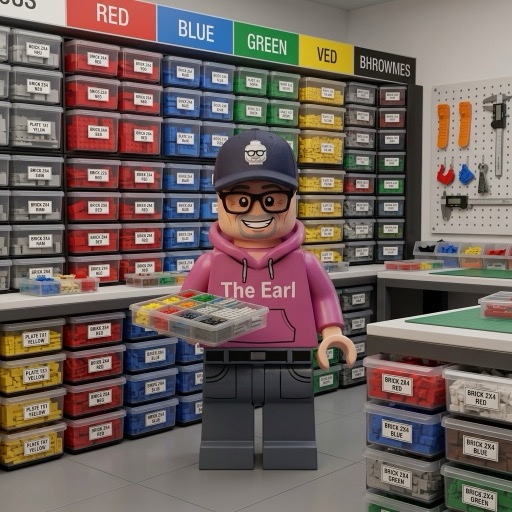
After 500 sets, your storage system becomes the difference between building and not building. Most people treat it as a one-time problem to solve, throw money at it, and move on. That's backwards. The system either accelerates your workflow or kills it every single time you sit down at the table. A bad setup doesn't just waste space, it wastes the mental energy needed to actually build. You spend twenty minutes hunting for the right shade of tan slope instead of thirty minutes on the MOC itself. That compounds.
What changed everything for me wasn't buying the right containers, though that matters. It was understanding that storage systems are built around how you actually build, not how you think you should build. Some builders work by set. Some by color. Some by element type. Some by scale. Most people pick the wrong system because they copied what looked good online instead of testing what works for their hands and their projects. The following approach worked after I stopped guessing and started paying attention to what my building process actually required.
Nobody starts collecting LEGO and thinks "I should plan my storage system." You buy a few sets, stack the boxes on a shelf, maybe build one or two of them. The boxes accumulate. Then you start displaying finished builds. Then you disassemble something to use the parts for a MOC, and suddenly you have a pile of unsorted bricks you don't know what to do with. Then you buy another set and notice that the piece you needed was in that pile somewhere, and you spend forty minutes looking for it, and you think: there has to be a better way.
By the time most collectors seriously address storage, they already have a problem. That was certainly true for me. My serious engagement with storage organization started somewhere around set number 150, well past the point where any solution was going to be tidy or fast to implement.
This is the account of what I tried, in roughly chronological order, why each system failed or succeeded, and what my current setup actually looks like. Your situation is different, your space constraints, budget, how you use parts, how often you rebuild, so take this as a set of options and honest assessments rather than a prescription.
Color sorting is the intuitive first answer. You can see what you have, it looks good in bins or drawers, and when you're building from a set your brain knows that "I need a red 2x4" means going to the red bin. Visually, it's satisfying. Practically, it has a fatal flaw: you never need "a red something." You need a specific part. And searching through an entire bin of red bricks for one specific connector or one specific plate is slower than not organizing at all.
I used color sorting for about eight months. The bins were attractive on the shelves. My building speed did not improve. My frustration with finding specific parts actually increased, because now there was an expectation that things were organized that set up a search that still didn't work. I was maintaining the appearance of order more than the function of it.
Color sorting works in one specific situation: large format MOC projects where you're using a lot of one color and you need to grab quickly from a color family. If you build that way, big projects in one or two dominant colors, a color-first system has merit. If you're building mostly from instructions or mixed MOCs, it doesn't.
After the color experiment, I swung to the opposite extreme: keep every set together, bagged by set number, with the instruction booklet stored with it. This is what the purist answer to the storage question usually looks like, you never lose parts, you can always rebuild, your sets are "complete" in perpetuity.
It's a perfectly legitimate system if your primary relationship to LEGO is display and rebuilding. It has no utility whatsoever for MOC building, because accessing any individual piece means finding the right bag among hundreds of bags and then re-bagging the rest when you're done. This system is, in effect, a way of having parts and still not being able to use them.
I kept set integrity for about a year on a subset of my collection, specifically, the modular buildings and the larger Creator Expert sets that I knew I'd want to rebuild in their original form eventually. For everything else, I moved to the next approach.
The honest assessment: if display and resale are your primary interests, set integrity is rational. If building is your primary interest, set integrity is a trap.
The approach that has worked, and continued to work as my collection has grown, is part-type sorting. Not by color, not by set, but by what the piece functionally is.
The categories I use: plates (all colors, sorted by size group, 1xN, 2xN, larger), bricks (same size-group logic), tiles (smooth top surfaces), slopes and curves, technic elements, minifig parts and accessories, specialty parts (curved, organic, unusual geometry), and transparent elements. Within each category, I don't sort by color, I sort by size. Within a size, pieces are mixed by color.
Why this works: when you're building, you know what shape you need before you know what color you need. You know you need a 1x2 plate, and then you look to see what colors you have in 1x2 plates. Searching a size-grouped container is fast. Searching a color-grouped container for a specific size is slow. Type-and-size sorting optimizes for the actual sequence of decisions a builder makes.
The storage hardware I use: the Akro-Mils 64-drawer storage cabinets are workhorses. They're cheap, stackable, and the drawer sizes accommodate most standard part sizes well. For larger parts, baseplates, large panels, bulk bricks, I use stackable shoebox-sized bins from IKEA. The total storage footprint is significant. I'm not going to pretend otherwise. If you're in an apartment or don't have a dedicated space, a full part-type system at this scale isn't realistic, and a hybrid approach, sorted by part type within limited storage, makes more sense.
The question everyone asks once they've decided on a system is: how do you get there from wherever you are? The answer is: slowly, with a defined scope, over time.
I did not sort my entire collection in a weekend. No one should try to do this. The right approach is to define a sorting session as a unit of time, two hours, Saturday afternoon, rather than a unit of completeness. You sort what you can sort in that window. You stop. You come back next time.
The order I sorted: minifig parts first (small volume, high utility, fast wins), then plates, then bricks, then everything else. Minifigs and plates are the parts you reach for most often, so getting those sorted early gives you immediate usability improvements that make the ongoing sorting feel worthwhile.
The one tool that made the biggest difference: a brick separator. If you're sorting loose bricks that have been stored together, they stick. The official LEGO brick separator, which costs almost nothing, is genuinely faster than fingers. Keep one at the sorting station at all times.
The time investment to fully sort a 500-set collection from scratch: I'd estimate 30 to 40 hours of actual sorting time, spread over several months of irregular sessions. It's a project, not a task. Plan accordingly.
After all of this, the failed systems, the successful one, the sorting project, the single decision that changed my relationship to the brick collection most dramatically was choosing to disassemble sets rather than display them.
For a long time, I built everything I bought and then found space to display it. The displays grew, the available building surfaces shrank, and I was managing a museum rather than building anything. The parts from those built sets were effectively frozen, decorating space rather than being available for use.
I made a deliberate decision to disassemble everything except about twenty sets with genuine personal significance, consolidate the parts into the sorted system, and stop displaying built sets as the primary output of the hobby. What I display now are pieces I'm actively working on or recently finished, not permanent installations. Everything else lives in the drawers, available.
The effect on my MOC output was immediate and dramatic. When every part is accessible, building becomes fluid. You have an idea, you go to the drawers, you have what you need or you improvise with what's there. The creative loop is short. When parts are locked up in built sets on shelves, the loop requires disassembling something first, which creates enough friction that the idea often doesn't happen.
This won't be the right call for everyone. Display is a legitimate and significant part of the hobby for many collectors. But if you buy sets primarily to build and you find that you're not building as much as you want to, the display habit is probably the reason, and the storage system is the enabler that frees you from it.
My system isn't perfect. No system at this scale is. But it works, and after trying three others that didn't, working is more than enough.
If you're starting fresh and want a practical shopping list rather than a philosophical framework, the LEGO organization guide has the exact bins, labels, and costs. And if you're building display bases, the MILS plate guide is the modular connection system worth understanding before you commit to a layout.
Most storage articles show you the containers and call it done. What they miss is that your storage system is only half of the equation. The other half is the workflow between where bricks live and where you build. A perfectly organized set of drawers means nothing if you're carrying individual containers back and forth across the room ten times during a single session. The distance from storage to building table, the number of trips required, the time spent digging through subdivisions you created three years ago, the frustration of finding out mid-build that the small red plate is in the wrong drawer, these are not problems with your containers. They are problems with your system design.
The guides that work best include not just storage but also a staging area. A secondary holding zone where you pull working bricks, sort them by immediate need, and keep them within arm's reach while building. This sounds like extra clutter. It is the opposite. Having a staging table or a specific set of trays that travel with you cuts build time in half because you stop hunting. You stop second-guessing whether a brick is in the storage or already pulled. You build faster because your hands never leave the work surface.